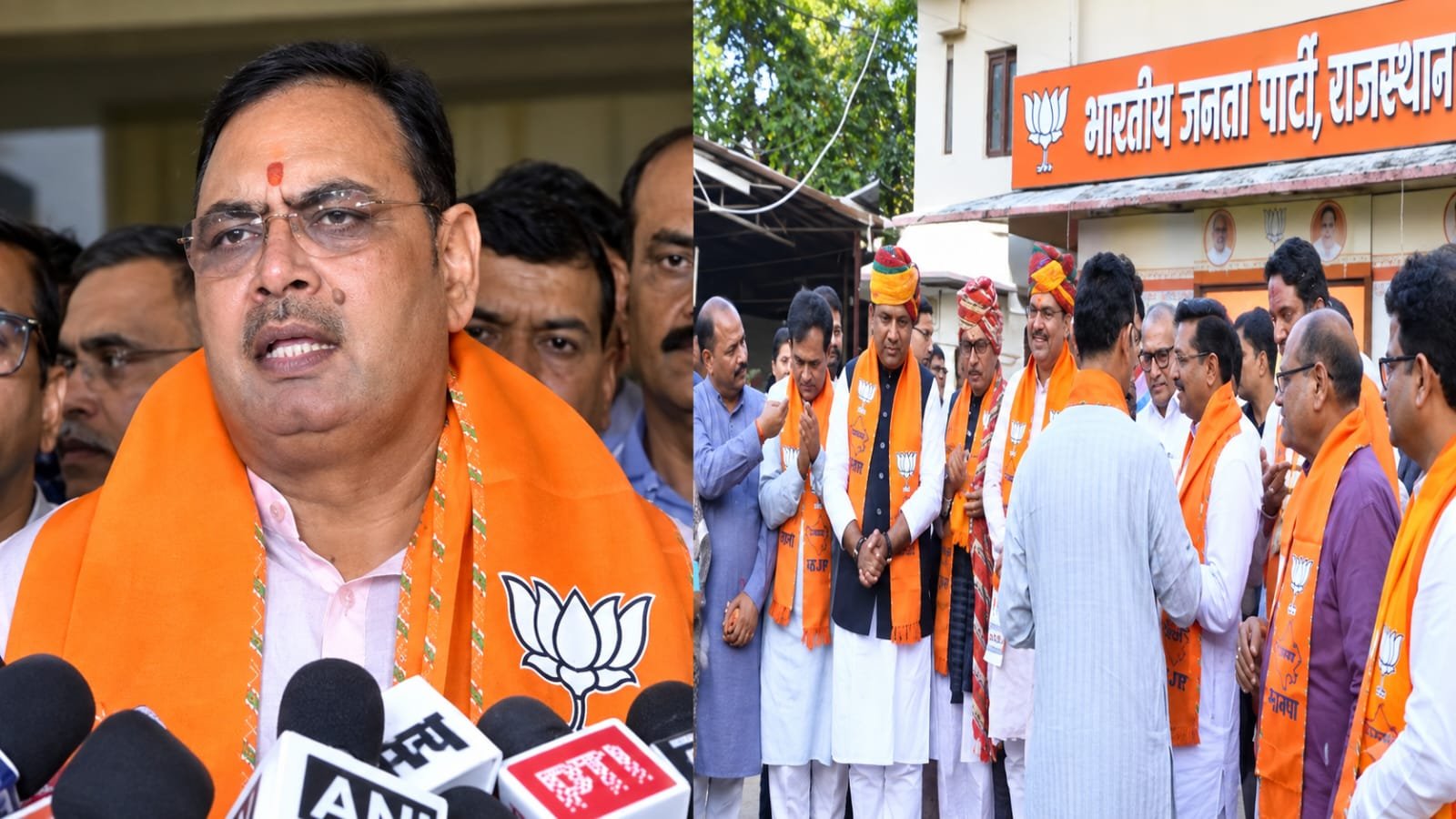
BJP Dominates Rajasthan Civic Polls!
The BJP has made a showing in Rajasthan urban local body elections by winning 41 percent of the wards while the Congress has managed only 35 percent. With seats added because of the delimitation process the BJP has taken a clear lead over the Congress.
The BJP has continued to build its strength in Rajasthan elections by taking 41% of the wards while the Congress has only managed 35%. This is a 5% increase for the BJP compared to the municipal elections while the Congress has lost about 5%..
It is a bit hard to compare directly this time because of the delimitation process, which caused a big rise in the total number of municipal seats, in Rajasthan.
Elections held in 309 civic bodies in Rajasthan.
Urban body elections in Rajasthan were held at three levels: Municipal Corporations, Municipal Councils and Municipalities/Nagar Panchayats. Municipal Corporations manage cities while Councils and Municipalities oversee the administration of towns.
A significant number of voters under the age of 40 participated in these elections. According to data as of 7 PM on September 14 results for 10 out of the 10,244 wards were still pending; the BJP led the Congress by 566 wards while independent candidates won 2,273 wards.
Compared to the civic elections held in four phases between 2019 and 2021 the electoral landscape was significantly larger this time. Due to the delimitation process 2,770 new wards were added in the state resulting in a 37.1 % increase in the total number of wards. While there were 7,474 wards in the previous election cycle that figure has now risen to, around 10,244.
BJP Dominates Rajasthan Civic Polls! BJP’s massive leap of 56.8%
In the civic body elections the Congress won, about 3,042 wards. The BJP secured 2,666 wards. Independent candidates took control of 1,672 wards.
Now in the results the BJP’s seat count jumped from 2,666 to 4,179. That’s a rise of 56.8%. The Congress also improved, going from 3,042 to 3,613 seats. That’s an increase of 18.7%.
Independent candidates also did well. Their number grew from 1,672 to 2,273. That’s a 35.9% increase.
So the BJP made the gain. The Congress. Not as much. Independents also gained ground.
RLP and CPI(M) also benefited.
I was surprised by the figures. The BJP secured the spot, in these elections by winning 4,179 wards, which is 40.8 percent of the total. The main opposition Congress came in second winning 3,613 wards, which’s 35.3 percent. Meanwhile the AAP, CPI(M) and Hanuman Beniwals Rashtriya Loktantrik Party all made gains.
Regional parties have also shown an improvement in the number of seats they won during these local body elections. The Rashtriya Loktantrik Party, which is led by Nagaur MP Hanuman Beniwal had 14 seats before. Now has 63 seats.
That is a jump of 350 percent. The Rashtriya Loktantrik Party has a lot of influence in areas where the Jat community’s the majority. These areas are, in the part of Rajasthan and the western part of Rajasthan. At the time the CPI(M) also did well. The CPI(M) had 8 seats before. Now has 38 seats. That is an increase of 375 percent.
In contrast the Bahujan Samaj Party (BSP) count fell from 24 wards to 19 wards a drop of 20.8 percent.
Congress suffers a 5.4% loss.
When looking at the proportion of wards the picture is clear: Congress share dropped from 40.7 percent in the previous election to 35.3 percent—a loss of about 5.4 percentage points.
Conversely BJP share rose from 35.7 percent to 40.8 percent marking a gain of 5.1 percentage points. The share held by candidates fell slightly moving from 22.4 percent to 22.2 percent.
This disparity is significant because BJP gains cannot be attributed to the creation of new wards. While the total number of wards, in the state increased by 37.1 percent BJP expanded its seat tally at a rate of 56.8 percent. In
Contrast Congress increased its seat count by 18.7 percent, half the rate of the ward expansion. Consequently even though the total number of wards has increased Congress still fell behind in overall share.
These results are politically significant for the government led by Chief Minister Bhajan Lal Sharma because the government led by Chief Minister Bhajan Lal Sharma assumed power after the December 2023 assembly elections. As is true in Indian states the ruling party, in Rajasthan has a natural advantage that comes from the administrative machinery organizational strength and the promotion of state-level development initiatives.
Local body elections however are shaped by issues, candidate selection, reservation policies, factionalism and the influence of independent candidates.
Rajasthan has been a swing state.
At the assembly level Rajasthan has always been a swing state. In the civic body elections the Congress, led by Ashok Gehlot was in power and had become the single largest party.. This time the situation changed completely.
The BJP, which is currently ruling made a push and gained momentum. Still the Congress managed to win 3,613 wards. This shows that the Congress still has a grassroots presence in Rajasthan. The party’s local network remains strong and active. Even though the BJP dominated the elections the Congress proved that it is still a force, in the state.
It is worth mentioning that cities have always been seen as an area for the BJP. These elections were seen as a challenge for the party because of the protests against the central governments UGC rules and the actions of the ‘Cockroach Janata Party’ (CJP). With these political events the BJP has not only kept its support, in cities but has also made it even stronger.

One thought on “BJP Dominates Rajasthan Civic Polls! BJP Wins 41% of Wards While Congress Is Restricted to 35%; Here’s the Full Breakdown.”